
If university isn’t for everyone, who isn’t it for?
Director of Programme Development and Impact, Dr Emily Magrath, asks if everyone has the same opportunity to choose their Post-18 pathway.
Director of Programme Development and Impact, Dr Emily Magrath, asks if everyone has the same opportunity to choose their Post-18 pathway.
 This summer, I spoke to a student who had finished school and wanted to do an apprenticeship as their next step. “Great.” I said. “Do you have one lined up?”
No.
Was there a particular apprenticeship they were aiming for?
No.
There wasn’t anything locally that they wanted to do or could apply for. They planned to wait and see what might appear or otherwise they would go to university next year.
I have found myself thinking about this conversation since then. What really stuck with me is that what sounded like a conversation about preference was more about availability, opportunity and whether all choices are equally open to young people.
At IntoUniversity each summer we call all the students we have worked with as they leave full time school education. Many are heading to university, some are taking up apprenticeships, some have started work, some are still weighing up options. Increasingly around these young people there is a public discourse that “university isn’t for everyone.” This is of course true and why our work at IntoUniversity is about supporting young people to make informed and empowered decisions about their futures, whether that includes university or another pathway.
Within this discourse I have found myself asking a different question: if university isn’t for everyone, who is it for? The answers can be revealing. There are discussions about choice, motivations, aspirations, skills and academic interests. Sometimes what is really meant is that university should be less expensive, debt should be lower – and that is certainly a driver of the decisions some young people are making. Sometimes people are saying they aren’t sure that a university degree is still as valued, or they are asking why alternative pathways don’t necessarily carry the same outcomes or life chances as a university route. Sometimes it’s less clear.
Beneath these conversations, there is not a simple shift towards an anti-university position. Recent polling by Public First found 81% of parents would still like their child to attend university. University also remains the destination of choice for most students of independent schools (with over 80% progressing to Higher Education). Additionally, a 2025 study by The Policy Institute at Kings College London found that only 8% of recent graduates would choose not to go to university again if given the choice, while 43% of 18-24 year olds without a degree wish that they had attended. Putting these together suggest that despite concerns about debt, cost and graduate outcomes, university remains a clear aspiration for many young people and their families.
As dialogue about non university routes grows, the key question then is who is being encouraged to take them? We should be careful not to create a situation where university continues to be seen as the expected choice for the most advantaged young people, while the conversation about other options is disproportionately directed at those from underserved communities. If we are serious about equality of opportunity, our aim should be to widen choice rather than limit it.
IntoUniversity’s recent university partner event Being Bolder Together: Widening Access in a Time of Challenge featured a panel of students and alumni from our programmes. They spoke with passion about why university was, or they thought would be, the right choice for them. However, they all acknowledged that within higher education spaces, they had not regularly seen students like themselves and spoke of the importance of representation: “You can’t be what you can’t see.”
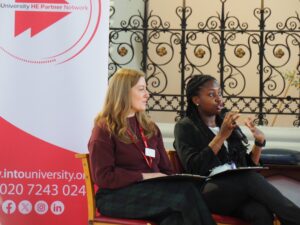
Alumna student speaking at our HE Partner Network Panel Event
During the event, one former IntoUniversity student talked about how they knew they wanted to attend university since they were 14 but also knew they would need support to achieve this. For them it was a combination of support from their parents, a teacher who championed and supported them at school, participating in a university access programme, attending IntoUniversity programmes including visiting universities and a place on our Big City Bright Future internship – all of this, alongside their clear motivation to attend, was key to the successful realisation of their ambition.
Of the many young people I have worked with, their aspirations and ambitions have been varied but often clear from a young age. Many do want to pursue careers for which university is a necessary step, from doctors and nurses, to teachers, scientists, astronomers or engineers. Some of these ideas will shift, but genuine choice depends on more than being able to scroll through course and university options on the UCAS website aged 17. It has to be about knowing how to do that effectively, having the confidence to make any choice and the qualifications to open the door. Some young people inherit professional networks, knowledge about higher education, confidence about navigating applications and an expectation that university is for people like them. Others need opportunities to build them.
This is why widening access work is still needed. It must provide an ecosystem around young people – to provide knowledge, experiences, relationships and encouragement that help turn aspirations into actual pathways. This makes me think of a young person who told me, they had always assumed they would go to a university in their city because IntoUniversity had kept taking them there since they were little. For universities then, this means continued long term investment in outreach and partnership despite changing rhetoric.
Some young people inherit professional networks, knowledge about higher education, confidence about navigating applications and an expectation that university is for people like them. Others need opportunities to build them.
We need equity of pathways across all our society and equity of the supply of opportunities regardless of geography. Like the conversation with the young person I spoke to earlier this summer, opportunities are not distributed evenly. It is about there being an equal valuing of different opportunities by parents, schools and by the government. Where that doesn’t exist we risk moving too quickly beyond ‘it isn’t for everyone’ to suggesting who it isn’t for. If that answer remains shaped by unequal access to opportunity, information or support, or unequal academic outcomes, then the work of widening participation is not done yet.
We should celebrate choice, but we should ask if everyone has the same opportunity to make it.