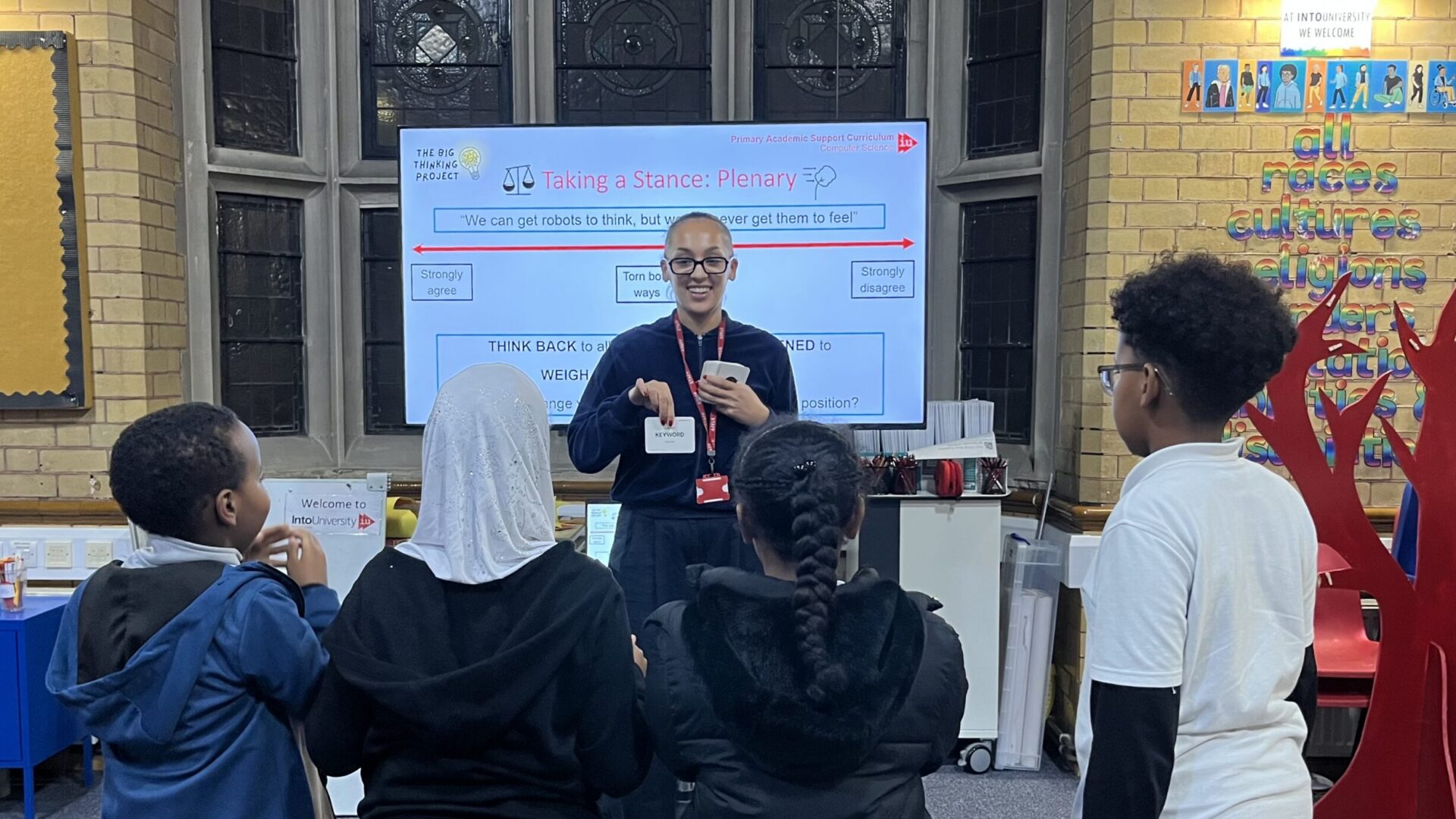
For young people experiencing disadvantage, learning and attainment gaps can appear early and grow over time. But when children start to understand how they learn and take charge of their thinking, their educational trajectories can shift. That is the promise of metacognition and why it has long been recognised as a powerful lever for learning. It is why it underpins our Theory of Change shaping how we support students to overcome barriers in and beyond the classroom.
Over the past year, we’ve taken that commitment a step further.
Thanks to funding from the Office for Students’ Equity in Higher Education Fund and a new way of working with our university partner Anglia Ruskin University (ARU), IntoUniversity launched a two-year pilot programme exploring how metacognition can be taught to primary aged children in our centres.
Why Metacognition, and Why Now?
Metacognition – an awareness and understanding of one’s own thought processes and how they can be purposefully directed – has strong evidence behind it. Research from the Education Endowment Foundation (EEF) also suggests that students from backgrounds experiencing disadvantage may be less likely to use metacognitive strategies unless explicitly taught them, and that metacognition can have a higher impact with such learners. This makes metacognition a promising route to narrowing attainment gaps.
The EEF also highlights metacognition as a high-impact, low cost way to improving academic outcomes but translating it into day-to-day practice is not always straightforward. Successful implementation depends on explicit, consistent instruction and opportunities for students to practise strategies. This is key for students to become independent metacognitive thinkers. Despite its importance, research exploring Metacognition in widening participation contexts is limited – another reason this pilot matters.
Known to our students as the Big Thinking Project, this work applies school-based research to our out-of-school setting. It has enabled co-design between academics, metacognition experts, curriculum specialists and practitioners, alongside development of a rigorous evaluation framework built with classroom realities in mind. This is allowing us to better understand what works for our youngest learners and how metacognition can be meaningfully assessed at this age.
Co-Designing a Curriculum That Brings Thinking to Life
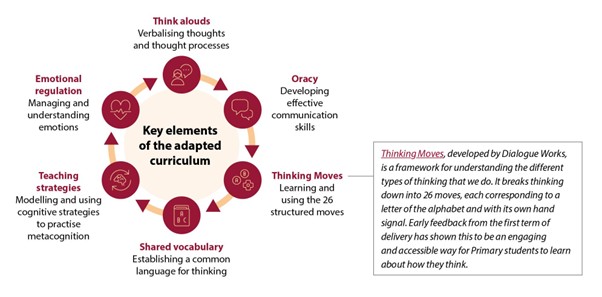
Building on that rationale, we have spent nearly two terms trialling an adapted version of our Primary Academic Support Curriculum with students who attend our centres after school each week. Drawing on insights from James Mannion and Kate McCalister’s Learning Skills programme, the revised curriculum introduces explicit metacognitive instruction and then embeds it into subject content over subsequent weeks. Two new core elements sit at the centre of this approach: the Thinking Moves (developed by Dialogue Works) and Think Alouds. Other components – Oracy, emotional regulation and learning reflections – were already part of our programme but have been further developed and given greater prominence. This has enabled us to design the curriculum around metacognition, ensuring every element helps students build, practise and strengthen their metacognitive thinking.
Collaboration has been crucial both across our organisation and with ARU. This includes key connections between our project and centre staff, and input on metacognition theory and evaluation design from ARU colleagues.
“Our strategic partnership demonstrates the power of bringing together academic research, evaluation expertise, and third-sector practice… we’ve been able to co-design an evidence-based intervention that aims to support young learners and strengthen the sector’s understanding of metacognition.” Bilal Hazzouri, ARU
These connections have allowed us to refine the curriculum in real time and enhance how third sector and university partnerships can work together through direct knowledge sharing, translating research-backed ideas and making them accessible, enjoyable and meaningful to the young people we collectively want to serve.
“Being part of the metacognition design team has given us an exciting framework and methodology to use in our own practice as facilitators. It has enabled us to equip young people with tools to become more confident, independent learners with greater agency in the teaching and learning process.” Ellery Child, Curriculum Design Team member, IntoUniversity Great Yarmouth
What have we learned? What are students telling us?
So far, we have begun to gather early learning, with the bulk of our formal evaluation scheduled for early summer. Staff feedback and observations have already helped us refine the curriculum and strengthen training for staff. We are observing benefits from the practical and tactile nature of the Thinking Move, seeing the development of students’ knowledge through the new curriculum format and how precision of language helps students reflect and practise metacognitive thinking.
“One thing which has stood out to me is how quickly our students have picked up the Thinking Moves. It feels really impactful to see students doing the corresponding move after reading a task in their workbooks.” Teyah Michalis, Centre Leader, IntoUniversity Bristol East
We are introducing student-led evaluation to hear directly from young people about the project’s value and impact and have so far enjoyed informally hearing positive feedback from students as we have visited sites over the year.
“My favourite thing about the Big Thinking Project is the Thinking Moves because they are fun. Practising the moves and remembering to use them in school has helped me with my learning. I like the ‘Picture’ move because it is very creative and it gives me a mystical kind of vibe” Marta, Primary Academic Support Student at IntoUniversity Peterborough
Looking Ahead
Our Impact Report 2025 reinforces our commitment to innovative, evidence-based practice. Projects like the Metacognition pilot not only enhance the support we offer to young people and families; they also help ensure our work remains high-quality, impactful and relevant. They give us space to test new ideas, refine our approach, and generate insights that will shape programmes across the organisation. We look forward to sharing more of what we learn and continuing to build an evidence base that strengthens the sector’s understanding of how metacognition can support younger learners.
Read the full Impact Report 2025 for more details on the project’s design and timeline.
Explore our Theory of Change here to see how metacognition supports student outcomes